DJI vows continued legal action after U.S. court orders to review its 'military company' designation_我的网站
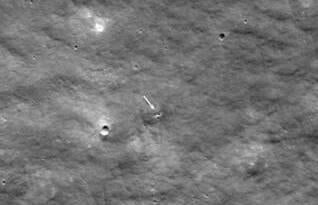
一 | Russia's Luna-25 probe likely left a 33-foot-wide crater on the surface of the moon last month when it lost control and crashed down, NASA said Thursday, revealing images that show the suspected impact site.Russia's first moon mission in 47 years ended in failure on August 19 when the Luna-25 probe smashed into the moon after a thruster firing went awry, cutting off communications and putting the spacecraft on the wrong orbital path, according to Roscosmos, the Russian space agency.NASA's Lunar Reconnaissance Orbiter (LRO) spacecraft captured images last week of what the U.S. space agency described as a "new crater" after Roscosmos published an estimate of where the probe had struck.During the descent to the surface on August 19, the Russian spacecraft Luna-25 experienced an anomaly that caused it to smash into the moon's surface. The faiint arrow in this NASA image shows where the agency believes the probe made impact. NASA's Goddard Space Flight Center/Arizona State University "Since this new crater is close to the Luna-25 estimated impact point," NASA wrote in a statement, "the LRO team concludes it is likely to be from that mission, rather than a natural impactor." Moscow has set up a commission to investigate exactly why Luna-25 crashed.The failure was a major disappointment for the Russian space program, which was attempting to up its game amid renewed interest in the moon's southern polar region, where ice deposits may exist in permanently shadowed craters. Ice could offer future space missions a way to produce breathable air, water and even hydrogen rocket fuel.
The Russians have had little success with independent space exploration since the Luna-24 robot landed on the moon in 1976. It scooped up about six ounces of lunar soil and returned it to Earth in Russia's third successful robotic lunar sample return mission.Twelve NASA astronauts walked on the moon a half century ago in the agency's Apollo program, but no Russian cosmonauts ever made the trip. Russia's only previous post-Soviet deep space robotic missions, both targeting Mars, ended in failure.
Former NASA astronaut breaks down India's moon landing04:34Luna-25 was an attempt to pick up the torch and put Russia back into a new space race of sorts, as the U.S., China, India, Japan and the private sector all plan multiple moon missions that could lay the foundations for lunar bases and eventual flights to Mars.India's Chandrayaan-3 Vikram lunar lander made a historic touch-down near the moon's south pole just several days after the Russian probe crashed. It delivered a lunar rover that has already sent back data from soil samples.
。 (ECNS) -- Chinese drone maker DJI said Monday it would continue its legal challenge after a U.S. federal appeals court ordered a lower court to review a case over the company's designation as a “Chinese military company” by the U.S. Department of Defense. DJI reiterated that it has consistently opposed the use of its products and technologies for any military or warfare purposes. The company said it would continue to defend the lawful rights and interests of DJI and its users worldwide through legal channels. The U.S. Court of Appeals for the District of Columbia Circuit ruled Friday that the lower court had erred in its review of whether DJI contributes to China’s defense industrial base, including by declining to examine classified evidence. The case was sent back to the U.S. District Court for the District of Columbia for further proceedings. DJI was first placed on the U.S. Department of Defense’s list of “Chinese military companies” in October 2022. After repeatedly opposing the designation, the company filed suit in October 2024. A district court upheld the designation in 2025, and DJI later appealed. (By Intern Yang Hongran, Zhang Dongfang) 。
Current article:http://qy7o5.fanfutaopoulaxiong.pics/list_0shs8h/ihte.html


 。
。