一 | (ECNS) -- At the "Sweet Light" modern sugarcane industrial park in Quli Town, Fusui County, in Chongzuo, south China's Guangxi Zhuang Autonomous Region, sugarcane varieties including Guitang 44, Yunzhe 081609, Guitang 76, Zhongtang 3, and Zhongfu 1 are thriving, with most stalks standing more than three meters tall. The park rotates several varieties and plants them in separate zones to keep yields stable and the fields ecologically resilient. Yang Xue, who has worked in the sugarcane industry for eight years and now runs an agritech company, has watched the shift from farming by experience to farming by data. Virus-free seedlings and the cultivation methods that go with them can extend ratoon cropping from three years to about five, he said, with germination rates reaching 95%. "In Chongzuo, per-hectare sugarcane yield used to be around 60 metric tonnes. With new varieties, improved cultivation methods, and planting models, yields have now risen to 72 metric tonnes," he said. To manage the park's 333 hectares of contiguous fields, Yang's team has installed a smart irrigation system that combines water, fertilizer, and pesticide application. It can be run from a computer or a mobile app, with irrigation timing, flow, and volume set precisely. One worker can now cover more than 67 hectares. The system has since been upgraded to a dual-pipe design, Yang said, allowing water, fertilizer, and pesticides to be applied together and accurately. Annual electricity costs have fallen from 1,200 yuan (about $168) per hectare to 750 yuan (about $105). Four workers can now fertilize 40 hectares in a day, work that previously took 30 workers to cover less than seven hectares. Mechanized harvesting has cut costs as well. Cutting and loading by hand costs more than 16,500 yuan per hectare, based on a yield of 105 metric tons per hectare and a rate of 160 yuan per metric ton. With machine harvesting, farmers receive a state subsidy of about 3,000 yuan per hectare and pay only 750 to 1,200 yuan for the service. The park also returns chopped stalks to the fields, saving another 450 to 600 yuan per hectare in fertilizer. The Chinese Academy of Tropical Agricultural Sciences (CATAS) has been working with the Guangxi Academy of Agricultural Sciences and other institutions on variety improvement, seedling propagation, pest control, green cultivation, and mechanical harvesting. Wu Qibin, a researcher at the Sugarcane Research Center of CATAS's Institute of Tropical Bioscience and Biotechnology, said Guangxi is China's core sugarcane-producing region, with more than 800,000 hectares under cultivation and over 60% of national sugar output. The industry is now pursuing two main goals, he said: breeding high-quality varieties suited to machine harvesting, and developing specialized machinery matched to those varieties. (By Tang Yuxian) 
 。
。 微软员工今年不仅在比较薪资,还开始比较自己用了多少AI。 根据泄露的一份微软内部的电子表格,数百名员工自愿匿名披露了自己的加薪、奖金和股票奖励,同时还记录了过去一个月使用AI工具的开销。 目前,微软正向员工提供一款内部工具,用于追踪他们的AI使用情况和相关支出。微软发言人表示,这款AI使用追踪工具目前仍处于早期测试阶段。 当前,微软正加速追赶Meta、谷歌、OpenAI、Anthropic等竞争对手,大力开发AI产品,公司在AI基础设施上投入数千亿美元,并推动员工将AI融入日常工作。

二 | 与往年相比,今年的电子表格新增了一栏,要求员工通过内部工具自行填写“每月AI使用金额”(AI $ Usage Per Month)。 这份电子表格泄露时,表格上共有近600名微软美国员工的记录,内容包括员工自称今年获得的基本薪资、加薪、现金奖金和股票奖励等。

三 | 当时,其中约350人已经填写了自己的AI使用金额。
四 | 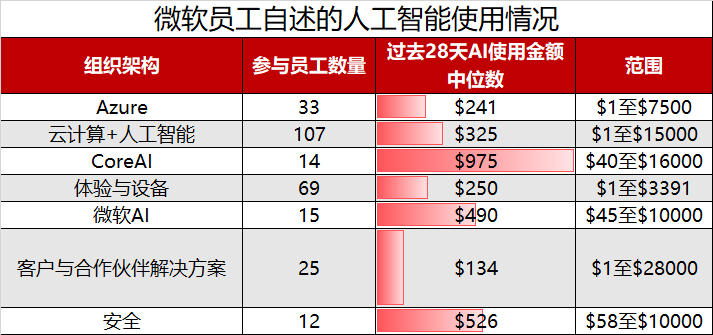 微软员工通常会自愿、匿名分享这些信息,以促进薪酬透明度,但这也意味着相关数据并非官方数据,也不完整。 截至6月30日,微软共有22.3万名员工,因此,这份仅包含约350名员工的表格,只是一个非常有限的样本。 在这些已报告的数据中,过去28天每位员工AI使用金额的中位数约为300美元(约合人民币2016元)。最高纪录来自微软“客户与合作伙伴解决方案部门”的一名员工,达到2.8万美元(约合人民币19万元)。 数据还显示,不同团队之间的AI使用量差异巨大:有些员工每月只花几美元,有些人的使用金额则达到数万美元。 媒体分析发现,在这份电子表格中,员工报告的AI使用金额与其获得的奖励之间并不存在明显关联。 简单来说,更高的AI使用量并未对应更高的奖金评级、更大幅度的绩效加薪,也没有显示出更高的晋升概率。

五 | 需要指出的是,微软并非唯一一家试图了解员工如何使用AI的科技巨头。随着各大科技公司投入数十亿美元开发AI模型和基础设施,整个科技行业都在加强对AI使用情况的追踪。 (文章来源:财联社)。
Current article:http://qy7o5.fanfutaopoulaxiong.pics/list_6btqyta/lsh69.html
Published on:10:16:09

 微信
微信
 移动端
移动端